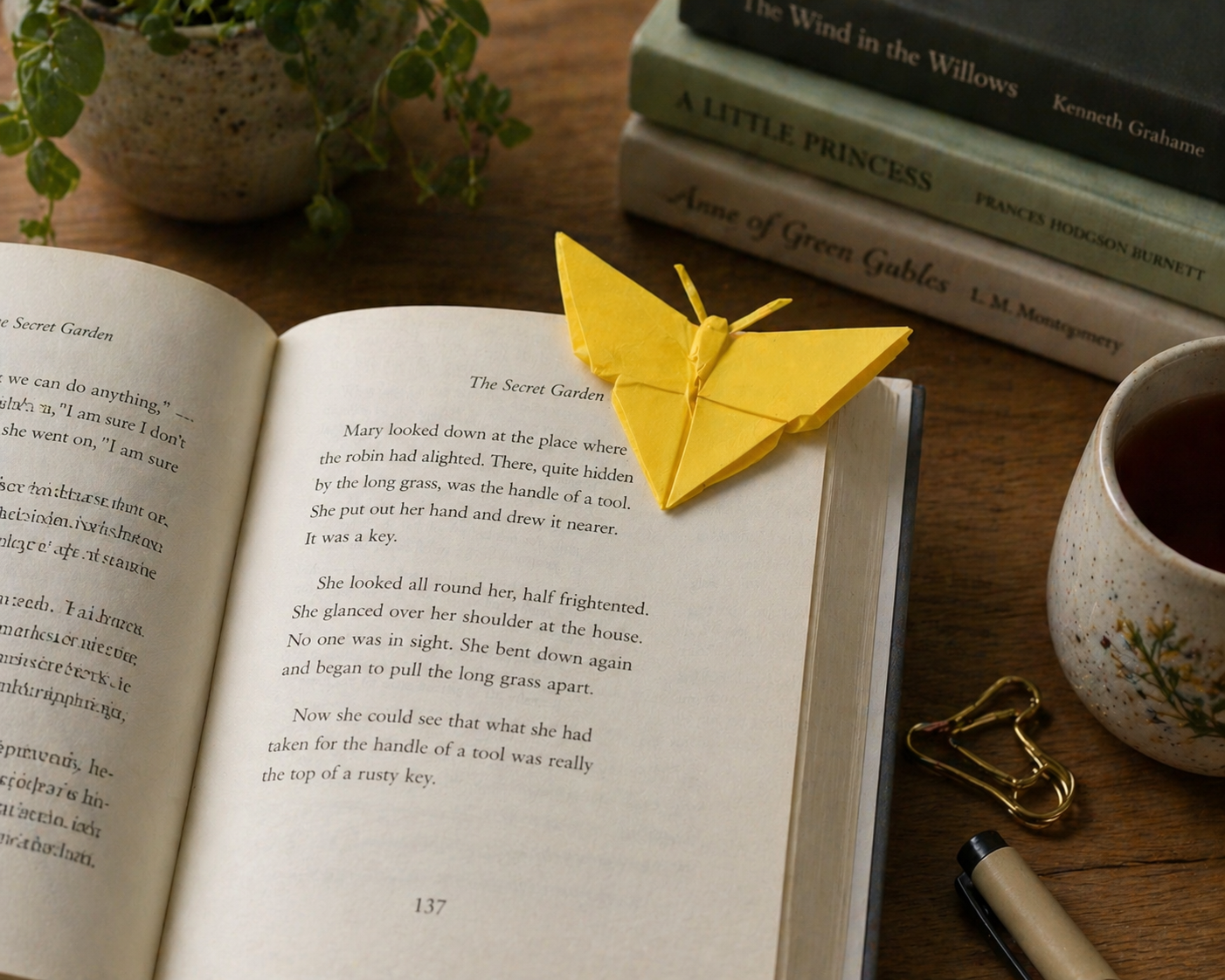
My first experience was at an origami workshop, and I learned to create a butterfly-shaped paper bookmark. That got me fascinated with the world of origami.
You might think of origami as simply folding paper into different shapes.
However, behind each fold lies a story that has traveled across centuries, cultures, and creativity itself.
Origami is an ancient art of paper folding. When you hold a piece of paper, a narrative begins to reveal itself through precise folds and imaginative designs, as the sheet transforms into cranes, flowers, and intricate geometric shapes.
In this way, you continue a tradition that has quietly, beautifully, and meaningfully evolved over time.
Where It All Began
Origami traces its roots back to the 6th century, when paper itself was a rare and valuable material introduced to Japan by Buddhist monks.
Initially, folding paper was more than just art, as it was primarily used for religious and cultural ceremonial practices.
The word “origami” comes from the Japanese words “ori,” meaning “folding,” and “kami,” meaning “paper.”
In those early days, it was used in rituals to purify offerings and often symbolized good fortune, being included in gifts as a gesture of respect.
Over time, what began as a tradition evolved into a celebrated global art form that became part of daily life. Origamic embodies simplicity, mindfulness, and the beauty of creation.
From Ritual to Recreation
When paper became more accessible, origami evolved into a popular pastime that attracted a wider audience.
Origami was used beyond ceremonial practices and became commonplace in homes, schools, and communities.
Folding paper no longer required a special occasion. It became a canvas for storytelling, especially for skilled artists.
During the quiet act of creation, you find joy, creativity, and acceptance of imperfections.
Simple models like cranes, jumping frogs, and boats became widely known.
And as a result, origami became a shared experience—something passed down from one generation to the next.
More importantly, the standard square sheet of paper served as the starting point, but different paper sizes and shapes were tested, expanding the possibilities.
Artists began experimenting with new techniques, complex folds, and innovative designs.
Gradually, origami evolved from a traditional craft into a contemporary art form.
Origami in the Modern World
Today, origami extends beyond paper cranes. Artists and mathematicians use advanced techniques, such as crease patterns, to map complex folds.
Another technique is modular origami, in which many folded pieces are assembled into large three-dimensional structures.
While wet folding is a technique in which paper is slightly moistened to allow smoother curves, it has opened up new possibilities.
These innovations helped create highly detailed, realistic models.
You’ll find it in:
- Art installations
- Architecture and design
- Education and problem-solving
- Even science and technology
Interestingly, the principles used to fold paper are now applied to the design of space structures and medical tools.
Artists are now experimenting with a range of materials, including fabric, metal, and even plastic.
What started as a cultural practice has now influenced modern innovation.
Why It Still Matters to You
In a fast-paced, digital world, origami provides a timeless practice and offers benefits beyond artistic expression.
Experience Mindfulness & Relaxation: The process of precise, repetitive folding requires your undivided focus and presence of mind. Each fold becomes a moment of presence, and you let go of stress and worries. It asks you to slow down, which has a calming effect and supports your emotional well-being.
Brain Stimulation: While exploring different folding techniques, both the left and right hemispheres of the brain are stimulated. This enhances creativity, problem-solving skills, and spatial awareness.
Patience & Concentration: Every fold in Origami requires precision, which trains the mind to focus on the task at hand. The process is time-consuming, so patience is essential, as you may spend hours or even days on a single creation.
Sense of Achievement & Experimentation: As you complete each new origami model, you feel a sense of satisfaction. There is also room to experiment and create your own unique models, which fosters innovation.
Because of all this, origami continues to captivate—as both art and lived experience.
Final Thoughts
At first, you may follow instructions, but over time, something shifts.
You begin to understand the rhythm of folding.
You begin to enjoy the process, not just the outcome.
Eventually, you realize origami is more than just paper.
It asks for patience.
It’s about creativity.
It’s about transformation.
You don’t need to be an expert to appreciate origami. You just need curiosity and a willingness to try.
Because every fold tells a story—of where origami began, how it evolved, and how it continues to inspire.
And when you sit down with a single sheet of paper, you become part of that journey.
For the letter T. This post is a part of BlogchatterA2Z Challenge 2026.